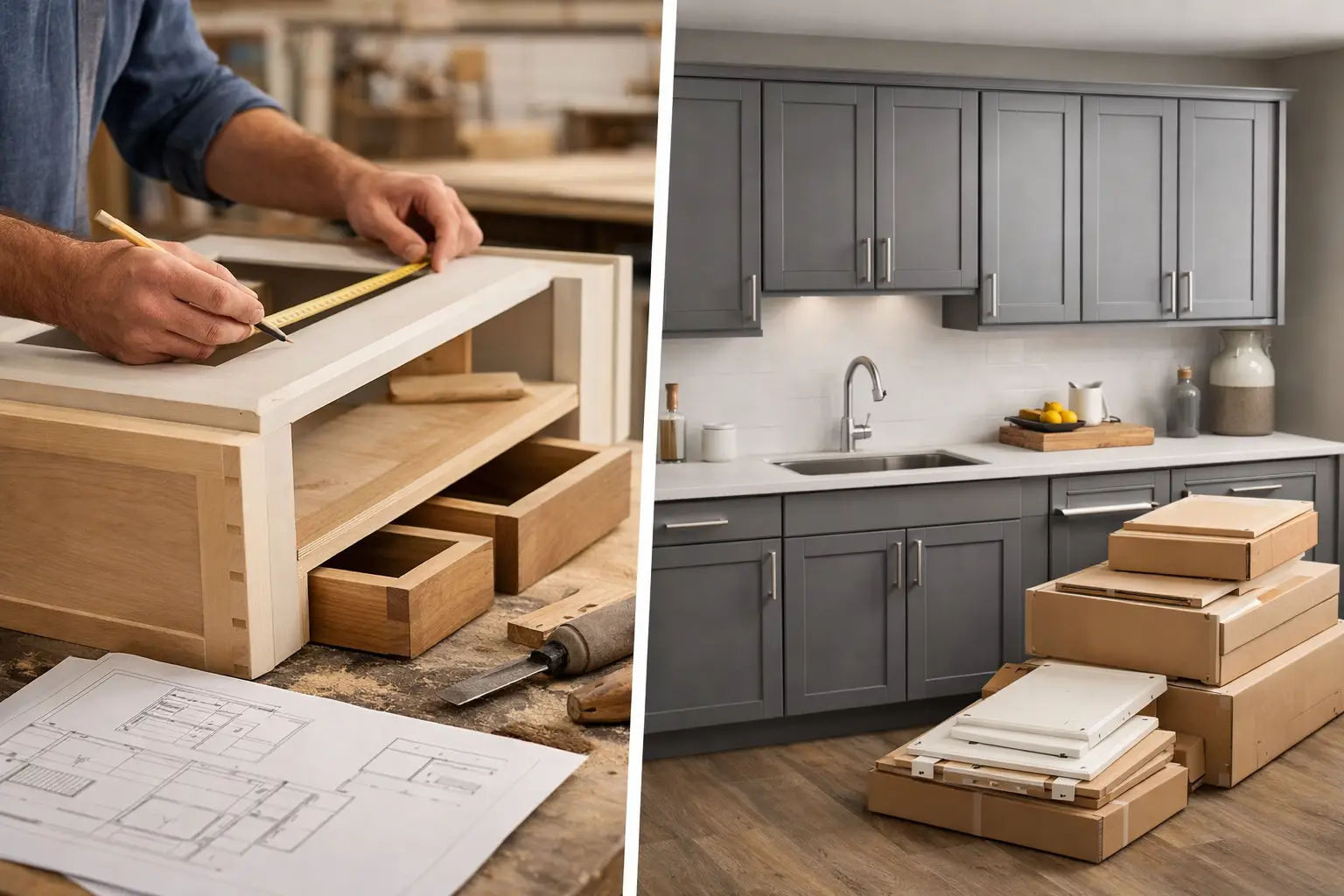
When a kitchen remodel starts taking shape, one decision tends to affect almost everything else – budget, layout, storage, finish selections, and even the project timeline. That is why custom cabinets versus stock is not just a style choice. It is a planning decision that influences how well your new kitchen works every day and how smoothly the renovation moves from design to installation.
For North Dallas homeowners, the right answer often comes down to how you use the space, how long you plan to stay in the home, and how exact you want the finished result to be. Stock cabinets can be a smart fit in some remodels. Custom cabinetry can be the better investment in others. The key is understanding what you gain, what you give up, and where the trade-offs matter most.
Custom cabinets versus stock: the core difference
Stock cabinets are pre-manufactured in standard sizes, styles, and finishes. They are built for broad use, which means they are designed to fit common kitchen layouts without much modification. You choose from a set catalog of options, and the installation team works within those dimensions.
Custom cabinets are built specifically for your space. That means cabinet widths, heights, depths, storage features, door styles, wood species, paint colors, and interior organization can all be tailored to the room and to your goals. Instead of adjusting your kitchen plan to the cabinet line, the cabinetry is built around the plan.
There is also a middle ground some homeowners consider, often called semi-custom. That option allows more flexibility than stock while stopping short of fully custom fabrication. But if the question is custom cabinets versus stock, the main difference is simple: standardization versus precision.
Where stock cabinets make sense
Stock cabinets appeal to homeowners for one obvious reason – they can reduce cost. Because they are mass-produced, they are usually less expensive than custom cabinetry. They can also shorten the front end of the process when the selected line is readily available.
If your kitchen has a straightforward layout, standard ceiling heights, and no unusual dimensions, stock cabinets may deliver a good result without forcing major compromises. For a rental property, a light-value-add remodel, or a project where budget discipline is the top priority, stock can be a practical choice.
They also work well when the homeowner is comfortable choosing from a narrower range of styles and finishes. Many stock lines now offer attractive designs, and not every project needs highly specialized storage or one-of-a-kind detailing.
That said, stock works best when the room already cooperates. Once the space has odd corners, limited square footage, soffits, varying wall conditions, or a strong need for better storage, the limitations become more noticeable.
Where custom cabinets earn their cost
Custom cabinetry is usually the better fit when the goal is to make the kitchen feel intentional from wall to wall. In older homes, remodelers often find dimensions that are slightly off, walls that are not perfectly square, and layouts that waste usable space. Custom cabinets help solve those problems cleanly.
Instead of filling gaps with wide trim pieces or accepting dead corners and awkward fillers, custom fabrication allows the cabinetry to meet the room more precisely. That can improve both appearance and function. A kitchen may gain more drawer space, better pantry organization, taller upper cabinets, or an island sized correctly for circulation.
Custom is also valuable when homeowners have specific design priorities. You may want inset doors, a particular paint match, concealed appliance panels, built-in spice storage, deep drawers for cookware, or cabinetry that extends to the ceiling for a more finished look. Those details are often difficult to achieve with stock lines, or they require enough compromise that the original vision starts slipping.
For primary residences where the kitchen is used heavily and the homeowners plan to stay for years, custom cabinetry can offer better long-term satisfaction. The benefit is not only appearance. It is having a space organized around real habits instead of generic dimensions.
Cost is important, but it is not the whole equation
Most homeowners begin with price, and that is reasonable. In a direct comparison, stock cabinets usually cost less upfront than custom. But cabinet pricing should be evaluated in context, not isolation.
If stock cabinets require design concessions, extra filler material, layout workarounds, or added labor to make standard sizes function in a nonstandard room, the savings can narrow. On the other hand, not every kitchen needs the investment of full custom work. Paying for customization that does not improve the outcome is not efficient either.
A more useful question is this: where will your money produce the most visible and functional return?
In some kitchens, the answer is better counters, improved lighting, and a strong stock cabinet line. In others, cabinetry is the central driver of storage, flow, and finish quality, which makes custom the wiser place to invest. A dependable remodeling plan should help you see those trade-offs clearly before work begins.
Design flexibility and storage performance
This is often where custom cabinets versus stock becomes easiest to evaluate. If your current kitchen frustrates you because it lacks organization, wastes corners, or leaves everyday items without a logical place, custom cabinetry offers a much higher level of control.
A well-designed custom kitchen can include drawer banks sized to your cookware, trash pull-outs where they belong, tray storage near cooking zones, vertical dividers for baking sheets, appliance garages, and pantry solutions matched to how your household shops and cooks. These are not luxury features for the sake of complexity. They reduce friction in a room you use constantly.
Stock cabinets can still improve storage, especially if the existing kitchen is outdated or poorly planned. But the improvements are usually tied to what the manufacturer already offers. If your needs fit that menu, stock may be enough. If they do not, the room may still look new while continuing to function like a compromise.
Timeline and project coordination
Homeowners often assume stock always means faster. Sometimes it does, but not automatically.
If the selected stock cabinets are in stock, lead times can be shorter than custom fabrication. That can help move a project along. But availability varies by brand, finish, and market conditions. Delays also happen when ordered pieces arrive damaged, incomplete, or discontinued.
Custom cabinetry usually requires more lead time because the cabinets are being built specifically for the project. That sounds like a drawback, but it can support a smoother remodel when the process is managed well. Measurements are verified carefully, design details are coordinated early, and installation tends to align more closely with the actual room conditions.
From a project management standpoint, the best cabinet choice is the one that fits the schedule realistically and is ordered with enough planning. A shorter theoretical lead time does not help if the selection creates layout issues or last-minute substitutions.
Quality depends on more than the label
It is easy to assume custom always means better quality and stock always means lower quality. That is too simplistic. There are strong stock lines and underwhelming custom shops. Material selection, joinery, finish application, hardware, and installation quality all matter.
What custom often provides is more control. You can make intentional choices about construction methods, wood species, finish durability, and interior accessories. With stock, those decisions are more limited, and quality depends heavily on the manufacturer’s standards.
This is why cabinet selection should never be disconnected from the remodeling team managing the project. Good cabinetry can be undermined by poor measurements or rushed installation. A disciplined contractor helps evaluate not just the cabinet category, but whether the product matches the demands of the space and the expectations for the finished result.
Which option is right for your home?
If your priority is controlling upfront cost, your kitchen layout is fairly standard, and you are comfortable with a narrower set of design options, stock cabinets may be the right solution.
If your kitchen needs to solve layout problems, maximize storage, support a specific design direction, or deliver a more tailored finish, custom cabinets are often worth the added investment.
Many homeowners do not need the most expensive option. They need the right one. That choice becomes clearer when the decision is tied to how the kitchen will be used, how long you plan to live in the home, and how important a precise fit is to the overall remodel.
At Yeager Properties, that is the kind of conversation a well-managed renovation should support – clear expectations, honest trade-offs, and recommendations that fit the house instead of forcing the house to fit a catalog.
The best kitchen is rarely the one with the most upgrades. It is the one that feels considered, functions well under daily use, and still looks right years after the remodel is finished.